
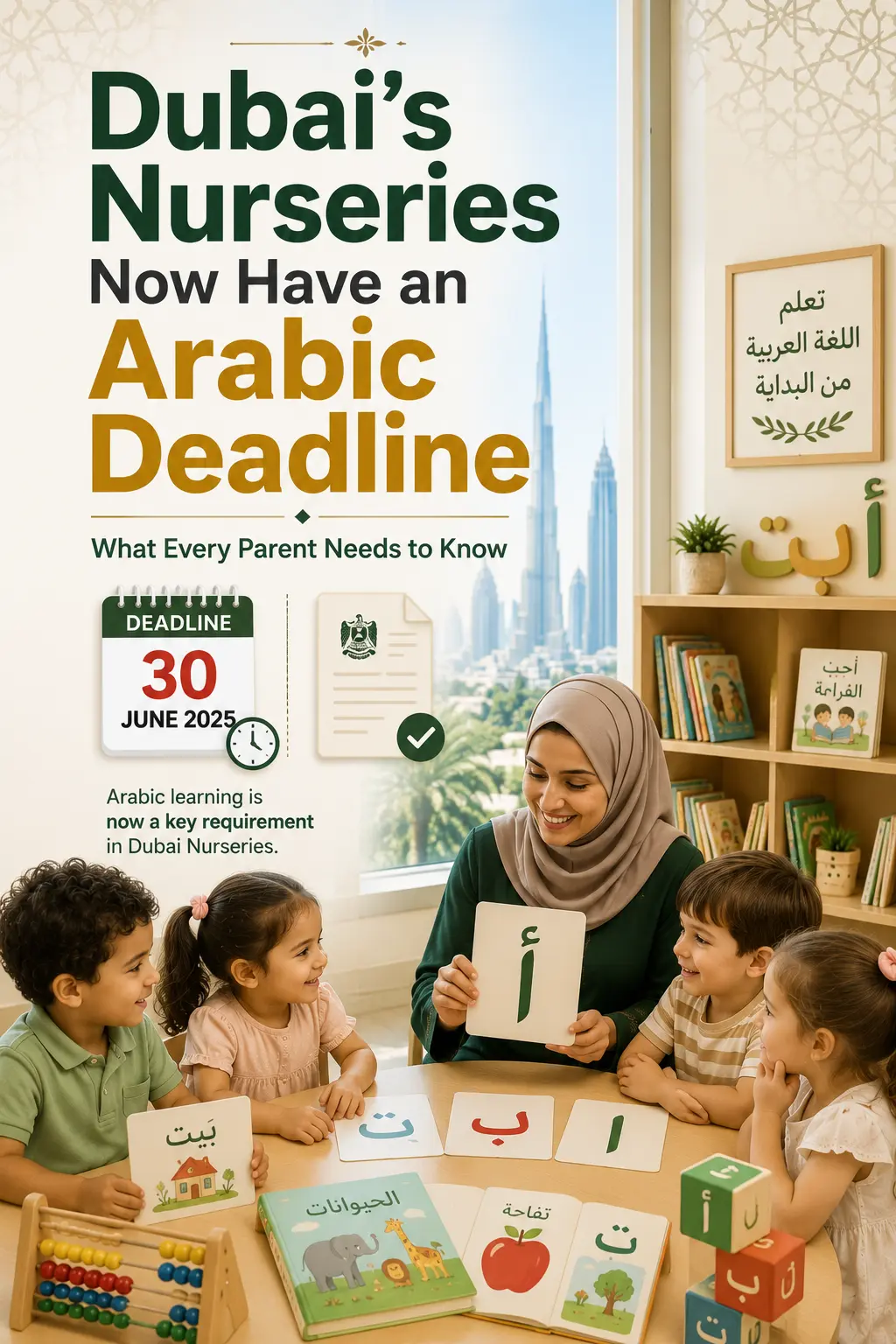
Dubai has introduced a mandatory Arabic language policy for early childhood education — and it’s already reshaping how parents are being told to evaluate nurseries. Here’s exactly what’s changed, what hasn’t yet, and what it’s worth asking before you choose one.
If you’ve recently toured a nursery in Dubai and heard the word “compliance” used in the same sentence as “Arabic,” you’re not imagining a new trend. Dubai’s Knowledge and Human Development Authority (KHDA) has introduced a formal policy requiring Arabic language provision across every private school and early childhood centre in the emirate — regardless of whether it follows a British, American, Indian, or IB curriculum.
The policy’s eventual scope is genuinely sweeping: Arabic exposure for children from birth to six years old. But it isn’t being switched on for every age group at once, and it’s worth understanding exactly where things stand today before you take any single headline about it at face value.
What’s Actually in Force Right Now
KHDA’s policy is being rolled out in three explicit phases, and only the first is currently active.
| Phase | Age Group | Status |
| Phase 1 | 4 to 6 years | In force since September 2025 (April 2026 for schools on an April academic year) |
| Phase 2 | 3 to 4 years | Not yet started — begins only after KHDA reviews Phase 1 outcomes |
| Phase 3 | Birth to 3 years | Not yet started — the final phase, timeline to be confirmed |
Source: KHDA’s Policy on Arabic Language Provision in Early Childhood Education, and KHDA’s official implementation guidance.
For the age group currently covered — 4 to 6 years — the requirement is specific: a qualified Arabic teacher must be present for at least one-third of a child’s weekly learning time, roughly 200–300 minutes, delivered through play-based, child-led activity rather than formal lessons.
No single Arabic teacher may be responsible for more than 75 registered children across their assigned classes, and nurseries have a three-year window from the policy’s start date to ensure all staff meet the required qualifications.
What this means in practice: if your child is between 4 and 6, the nursery or school you choose is now legally required to build meaningful, structured Arabic exposure into a genuine third of the week. If your child is younger than that, the legal requirement hasn’t reached them yet — Phases 2 and 3 are still to come, and KHDA has been explicit that it’s reviewing how Phase 1 goes before committing to a firm timeline for the rest.
What This Means If Your Child Is Under Four Right Now
This is the detail most parent forums and even some nursery marketing tend to blur, so it’s worth stating plainly: there is currently no enforced minimum Arabic requirement for toddlers and infants in Dubai nurseries. Phase 3, which will eventually cover birth to age 3, hasn’t begun.
That doesn’t mean the direction of travel is unclear. KHDA has stated the intention is for Arabic exposure to become “a normal part of every child’s environment from day one,” and the policy’s own stated destination is birth-to-six coverage.
For a toddler enrolling today, the honest way to think about it is this: the legal floor hasn’t arrived yet for their age group, but it is coming, and nurseries that are already building genuine Arabic immersion into daily life — rather than waiting for a compliance deadline to force it — are simply ahead of a curve most of the market hasn’t been required to climb yet.
Questions Worth Asking Any Nursery You’re Considering
Whatever age your child is, these are the specific, KHDA-anchored questions that separate a nursery that has genuinely built Arabic into its day from one that’s added a token session to look compliant.
- Is your Arabic teacher KHDA-registered, and how many children are they responsible for across their classes? (The policy caps this at 75.)
- How much of a typical week is genuinely Arabic — not a single scheduled “Arabic class,” but exposure woven through the day?
- Is the Arabic delivered through play, storytelling, and daily routine, or through a formal, textbook-style lesson block?
- For a child under 4, is there any structured Arabic exposure at all, given the legal requirement hasn’t reached that age group yet — or is it left entirely to chance?
- How does the nursery support non-native Arabic speakers differently from children who already speak it at home?
- Is Arabic treated as a cultural and identity foundation, or purely as a subject to be ticked off?
Where This Leaves an Arabic-First Nursery Like Alif Ya
Alif Ya was built around a different starting point to begin with. Since it opened, Arabic hasn’t been scheduled in as a subject — it’s been the primary language of the day, from infants as young as 45 days old through to Kindergarten, well beyond the one-third minimum that Phase 1 now requires for 4 to 6 year-olds, and well ahead of where Phases 2 and 3 are eventually headed for younger children.
This isn’t a claim of certification or inspection status — that’s a matter for KHDA’s own published ratings, and any parent evaluating a nursery under the new policy should ask to see those directly, at Alif Ya or anywhere else. What it does mean, honestly, is that Alif Ya’s day-to-day model — full immersion, Arabic storytelling and songs, a weekly rhythm built around Islamic and Emirati cultural practice, and English introduced alongside rather than instead of Arabic — was never built to satisfy a minimum.
It was built around the same idea the policy is now catching up to: that language and cultural identity take root earliest, and take root best, in daily life rather than in a scheduled period.
Alif Ya’s Branches, and What’s Nearby
For parents comparing nurseries specifically against this new Arabic-provision landscape, here’s a quick, honest look at each Alif Ya location.
Nad Al Sheba
Nad Al Sheba, Meydan & Mohammed Bin Rashid City
One of the busiest branches for families in the Nad Al Sheba and Meydan belt. Covers all age groups from 45 days through Kindergarten, with private tours available to walk through the Arabic-immersion model directly before enrolling.
Al Mizhar 1
Al Mizhar, near Mirdif
Serves families across Al Mizhar and the wider Mirdif catchment. Same full-day Arabic immersion model and age-banded programmes (Butterflies through Knights), with the same emphasis on daily cultural practice rather than a scheduled Arabic slot.
Al Mizhar 4 (Oud Al Muteena)
A particularly popular branch among toddler families, with purpose-built spaces for the 1–3 age group — an indoor gym, outdoor play areas, an Atelier for sensory and art activities, and role-play zones, all conducted in Arabic-first daily routine.
Al Barsha
Serves families across Al Barsha looking for the same immersion model closer to the Sheikh Zayed Road corridor — daily Arabic practice, Friday Islamic observance, and the same Creative Curriculum framework adapted around Arabic language and Emirati culture.
Every branch runs the same underlying philosophy — the difference between them is simply which one is closest to home.
| Alif Ya Nursery — four branches across Dubai, built around full-day Arabic immersion since day one. |
Frequently Asked Questions
Q. Is Arabic mandatory in all Dubai nurseries now?
For children aged 4 to 6, yes — Phase 1 of KHDA’s policy has been in force since September 2025 (April 2026 for April-start schools), requiring at least one-third of learning time with a qualified Arabic teacher present. For children under 4, the requirement hasn’t taken legal effect yet; Phases 2 and 3, covering ages 3–4 and birth–3, are still to be rolled out.
Q. Does this policy apply to nurseries following non-Arabic curricula, like British or American programmes?
Yes. The policy applies to every private school and early childhood centre in Dubai regardless of the curriculum they follow.
Q. My child is 2 years old — does the new rule affect their nursery choice?
Not as a legal requirement yet, since Phase 3 (birth to 3 years) hasn’t started. It’s still worth asking any nursery how they approach Arabic for toddlers, since KHDA has stated this is the direction the policy is heading.
Q. Is Alif Ya Nursery KHDA-certified or compliant with the new policy?
Alif Ya’s day-to-day model has been built around full Arabic immersion since it opened, which goes beyond the current one-third minimum required for the 4–6 age group. For specific inspection ratings or certification status, parents should ask to see KHDA’s published reports directly, as they would for any nursery.
Q. Which Alif Ya branch is closest to me?
Alif Ya operates four branches across Dubai: Nad Al Sheba, Al Mizhar 1, Al Mizhar 4 (Oud Al Muteena), and Al Barsha. Each runs the same Arabic-immersion model and age-banded programmes from 45 days through Kindergarten.
The headline version of this story — “Arabic is now mandatory for every nursery in Dubai” — is close to true, but not quite there yet for every age group, and the gap matters if you’re choosing a nursery for a toddler rather than a 5-year-old.
What’s genuinely true is the direction: Dubai’s early years policy is moving toward Arabic as a daily foundation rather than a scheduled subject, and nurseries that were already built that way have far less catching up to do than the ones only just starting.
| Alif Ya Nursery — Nad Al Sheba, Al Mizhar 1, Al Mizhar 4, and Al Barsha. |