

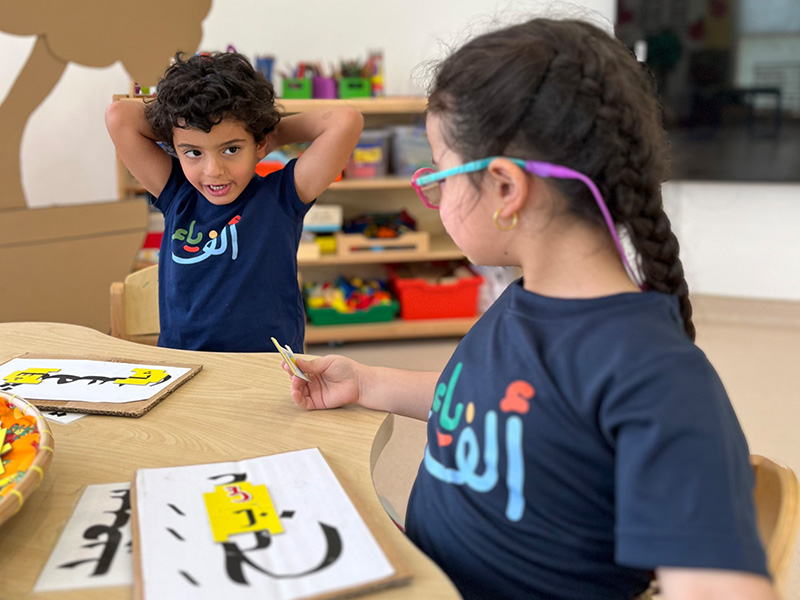
Every parent asks some version of the same question before their child’s first day: is this going to be awful? Usually not, though it can look that way for an hour or two on Monday morning. Here’s what actually tends to happen, day by day, and why the version that looks the roughest is often the one that’s working exactly as it should.
Monday
Most children cry at drop-off on day one. Not all of them, but enough that it’s the norm rather than the exception, and it rarely means anything has gone wrong. A new room, new faces, and a parent who’s just walked out the door is a lot to process for someone who’s two or three years old. What matters more than whether there are tears is what happens in the ten minutes after — most children settle faster than parents expect once they’re actually inside, distracted by a toy, a song, or another child doing something interesting.
At Alif Ya, that first day usually involves a shorter session than a full day, and a key teacher whose job is specifically to be the familiar face your child returns to each morning. Comfort items from home — a blanket, a small toy — are welcome for exactly this reason. It’s a lot easier to feel safe somewhere new when something familiar comes with you.
Tuesday and Wednesday
This is usually where the pattern starts to shift, though not always in a straight line. Some children have an easier second day and then a harder third. Others improve steadily. Both are normal. What you’re looking for isn’t a smooth, uninterrupted upward curve — it’s a general trend, over the course of the week, toward less distress and faster recovery once you’ve actually left.
Read Also;
By midweek, most children have started to recognise the room itself, and recognition does a lot of the emotional work that reassurance alone can’t. They know where the toys are kept, which corner has the books, what happens after snack time. None of that needs to be explained to them anymore, and a routine that doesn’t need explaining is a routine that starts to feel safe.
Thursday
For many children, this is the day a parent gets the update they’ve been hoping for — that their child stopped crying within a few minutes, or didn’t cry at all. It doesn’t happen for everyone by day four, and that’s fine too. Some children genuinely take two or three weeks rather than one, and that’s still within the range of ordinary, not a sign that something’s wrong.
This is also usually when the first real glimpses of a child’s own personality start showing up at nursery specifically — which child gravitates toward music, who wants to lead the group, who’d rather sit quietly with a puzzle. Teachers start forming a genuine picture of a child as an individual, not just as “the new one.”
Friday
A good first Friday often looks almost unremarkable, and that’s the whole point. A child who walks in without a fuss, or with a brief one that passes quickly, has done something genuinely significant over the course of five days — built a working sense that this new place is safe, that the adults in it can be trusted, and that a parent leaving in the morning reliably means a parent returning in the afternoon.
That last part matters more than it sounds. Object permanence around people, not just things, is still developing in the toddler years, and a huge part of settling in well is simply proving to a child, through repetition, that “gone” at drop-off really does mean “back later” and never anything else.
What Actually Helps
A calm, unhurried goodbye tends to help more than a long, drawn-out one. Children pick up on a parent’s own anxiety quickly, and a quick, warm, confident goodbye — rather than several minutes of reassurance — usually settles a child faster than lingering does. It feels counterintuitive to leave quickly when your child is upset, but it genuinely tends to work better than staying to comfort them through it.
Consistency in the drop-off routine itself helps too — the same door, roughly the same time, the same short goodbye phrase each day. Routines are how young children build predictability into a world that otherwise feels fairly unpredictable to them, and a consistent goodbye ritual is one of the simplest ways to give them that.
It’s also worth saying plainly: every child settles at their own pace, and a slower week one doesn’t predict a difficult month one. If a particular child is still struggling well beyond what feels typical, that’s a conversation worth having directly with their key teacher, who sees the child’s day far more closely than a single drop-off ever could.
Why the Early Weeks Matter
At Alif Ya, settling in isn’t treated as a hurdle to get through before the “real” nursery experience begins — it’s part of it. Across the branches in Al Barsha, Al Mizhar, Nad Al Sheba, and Oud Al Muteena, the same principle holds: a child who feels genuinely secure in their environment is a child who’s actually ready to learn, play, and absorb a new language, rather than simply endure a new place.
The first week is rarely the easiest week. It’s usually the most important one.