
Every parent in Dubai wants their child to grow up responsible. The desire is universal — but the language we use to cultivate it is not. When responsibility is taught only through chores and routines, we give children a skill. When it is taught through language, values, and the living example of a culture that has held these principles for centuries, we give them a foundation.
In Arabic and Islamic tradition, responsibility is not primarily about tidying toys or following a morning routine. It is a moral category — woven into the concept of amanah (trust), structured by adab (ethical conduct), and embedded in the collective understanding that each person holds their actions in stewardship before Allah and community. This is a richer, older, and more complete framework for raising responsible children than any checklist can capture.
This guide draws on that framework. It offers nine concrete, practical strategies for raising responsible children — rooted in Arabic values and Islamic principles — that Dubai parents can use at home from the earliest years. And it shows how every one of these strategies is already alive, every day, in the classrooms of Alif Ya Nursery.
“My language. My identity.” — Alif Ya Nursery’s founding principle. And also, it turns out: a child’s most powerful path to responsibility.
The Arabic Framework for Responsibility: Five Concepts That Change Everything
Before the nine strategies, it helps to understand the concepts. These Arabic and Islamic terms are not abstract philosophy — they are practical lenses that reshape how we see our children’s capacity for responsibility, and how we speak to them about it.
أمانة (Amanah) — Trust; that which has been entrusted to you. Your body, your words, your relationships, your community — all held in trust.
أدب (Adab) — Right conduct; ethical comportment toward self, others, creation, and the Divine. The root of responsible behaviour.
مسؤولية (Mas’uliyya) — Responsibility; from the root sa’ala — to ask, to be answerable. To be responsible is to be answerable — to yourself, to others, to Allah.
تعاون (Ta’awun) — Cooperation; the value of collective effort. ‘And cooperate in righteousness and piety.’ (Quran 5:2)
محافظة (Muhafadha) — Stewardship; the active preservation of what has been entrusted — your environment, your heritage, your language.
When a parent says to a child in Arabic ‘haatha amanatuka — this is your trust’ rather than ‘this is your job,’ something shifts. The child understands that this thing matters beyond convenience. That it is held. That they are held.
This is what an Arabic-first nursery does that no other nursery in Dubai can do with the same authenticity: it places these concepts in a child’s mind at the age when concepts stick for a lifetime — not as vocabulary items, but as the air they breathe.
9 Values-Based Strategies for Raising Responsible Children — at Home and at Nursery
1. Name Responsibility in Arabic, From the Beginning
Language shapes thought. A child who grows up hearing ‘mas’uliyya’ alongside ‘responsibility’ develops two cognitive anchors for the same value — and the Arabic anchor carries additional weight because it comes embedded with the cultural and spiritual context of the tradition it belongs to.
At home: When your child returns a toy to its place, name what they have done — ‘Ahsant! Hathi mas’uliyyatouk.’ (‘Well done! This is your responsibility.’) The repetition of the Arabic word alongside the action creates the neural connection between the concept and the behaviour.
At Alif Ya: Arabic is not a language class that happens once a week. It is the medium through which every action, every correction, every praise, every daily routine is narrated and named. By the time children leave the Falcons class (age 4–5), mas’uliyya is not a word they have been taught. It is a word they have lived.
2. Teach Amanah Before Chores
Most parenting guides start with chores — put your toys away, set the table. These are valuable. But they teach efficiency, not meaning. When you frame a child’s tasks as amanah — as things entrusted to them that others depend on — you transform a chore into a commitment.
The Quranic concept of amanah (Quran 33:72) describes the trust offered to the heavens and earth that they could not bear, but which human beings accepted. For a three-year-old, this is not theology — it is the understanding, planted early, that they are capable of being trusted. That things are given to them because they can hold them.
At home: When you give a child a task, frame it as trust: ‘I am trusting you with this.’ When they complete it: ‘You kept your trust. Haafadtha ‘ala amanatik.’ This is more powerful than sticker charts.
At Alif Ya: Every classroom role in the Deers, Falcons, and Knights groups is framed as amanah — the plant caretaker, the book librarian, the line leader. Children understand they have been trusted, not merely assigned.
3. Model Adab — Because Children Watch Before They Listen
Adab — right conduct, ethical comportment — is the closest Arabic concept to what developmental psychologists call ‘social-emotional modelling.’ Children learn responsibility primarily by watching the adults around them live it. Not perfectly. But visibly, consistently, and without hypocrisy.
The Prophet Muhammad (peace be upon him) said: ‘The best of you are those who have the best adab.’ This is not a statement about manners in the narrow sense. It is a statement about character — and character is caught before it is taught.
At home: Let your child see you fulfil commitments. Let them see you apologise when you are wrong. Let them see you care for things — your home, your food, the natural world — as stewardship rather than ownership. Say, in Arabic, what you are doing and why: ‘Banadhafu al-bayt li’anna haatha wajibouna — We are cleaning the home because this is our responsibility.’
At Alif Ya: Teachers do not simply instruct children in values. They embody them — in how they speak, how they handle materials, how they resolve conflict, and how they observe Friday as a day of meaning rather than just a day before the weekend.
4. Introduce Ta’awun — Cooperation as a Religious and Cultural Value
The Quran instructs: ‘Wa ta’awanu ‘alal birri wa taqwa — And cooperate with one another in goodness and righteousness.’ (5:2) This verse is the foundation of the Islamic understanding of collective responsibility — the idea that what I do affects you, and that your wellbeing is part of my obligation.
Most responsibility curricula treat cooperation as a social skill. In the Arabic-Islamic framework, it is a moral one. The distinction matters because moral frameworks motivate differently from skill frameworks — they engage the heart, not just the behaviour.
At home: Frame helping tasks as ta’awun: ‘Al-usra ta’un ba’duha al-ba’d — The family helps each other.’ When siblings cooperate, name it: ‘Haatha ta’awun. Ma sha’a Allah.’ This language builds a child who helps because it is right, not because they have been rewarded.
At Alif Ya: Group learning activities are framed in Arabic through the lens of ta’awun. The classroom is a community, not a collection of individuals. Children learn to see their contribution to the group as a form of responsibility, not just participation.
5. Build Routine as Ibadah — Not Merely Habit
Routines are important. Every parenting guide agrees on this. But in the Arabic-Islamic tradition, there is a dimension to routine that secular frameworks miss: the concept of ibadah — worship, the orientation of one’s actions toward what is good and right. When a child’s morning routine includes wudu, prayer, and intention (niyya), they begin to understand that how they start the day is a statement of who they are.
This is not about imposing religious obligation on toddlers. It is about giving children a sense that their daily actions have meaning and direction — that cleaning their teeth, preparing for the day, and caring for themselves is part of a larger project of being a person who is responsible before Allah.
At home: Include simple, age-appropriate Islamic practices in the morning routine. Name them as you do them. ‘Bismillah, nandhafu wajhana — In the name of Allah, we wash our face.’ The repetition builds the connection between action and intention.
At Alif Ya: The Friday tradition — where children learn about the significance of the day, perform wudu, and join congregational prayer — is the clearest expression of this strategy in action. Responsibility for one’s own body, for the community, and for the sacred day is built into the rhythm of the week.
6. Give Real Responsibility — Not Pretend Responsibility
One of the most common mistakes in teaching responsibility is giving children tasks that don’t actually matter — play chores with no real consequence. Children sense this immediately. Real responsibility means real impact: if they don’t water the plant, the plant will be thirsty. If they don’t return the book to the shelf, someone else won’t find it. If they don’t come to prayer on time, the line begins without them.
Developmental psychology confirms this: autonomy-supportive environments — where children make choices with real consequences — produce significantly more intrinsically motivated, responsible behaviour than controlled environments where children simply follow instructions.
At home: Assign tasks that genuinely matter. The youngest child in the family can be trusted with putting the napkins on the table. The task matters. They matter because they do it. ‘Al-aila tanthiru ‘alayk — The family is waiting on you.’
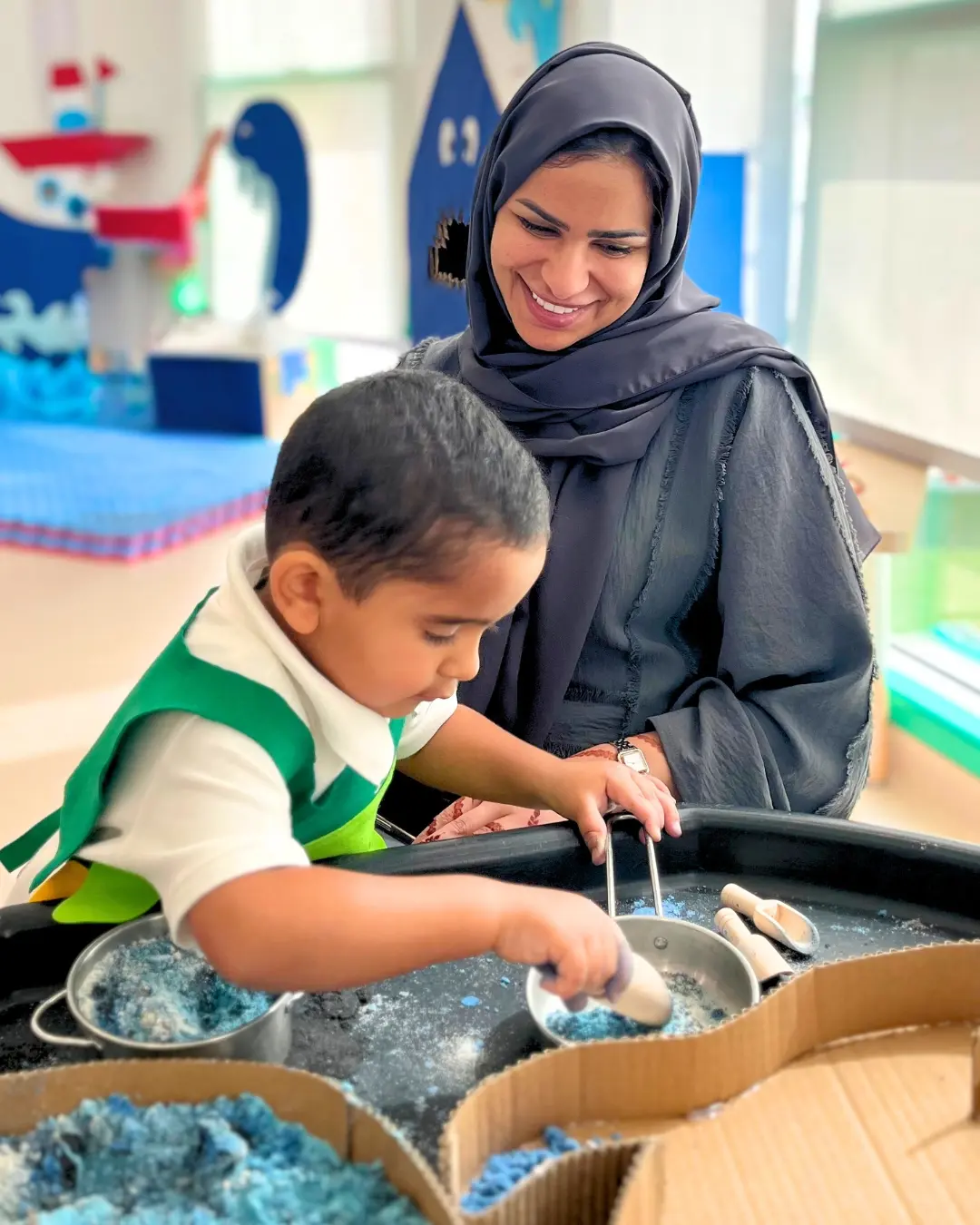
At Alif Ya: Every age group from Bees upward has genuine classroom responsibilities — not simulated ones. The plants are real. The books are real. The prayer line is real. Children at Alif Ya know their contribution matters because they can see it does.
7. Teach Muhafadha — Stewardship of Language, Heritage, and Environment
Muhafadha — the active preservation and stewardship of what has been entrusted — is a concept that goes beyond individual responsibility into the responsibility of belonging. What does it mean to be the inheritor of a language? Of a heritage? Of an environment? The Quran appoints humans as khalifa (custodians) of the earth — a concept that roots environmental responsibility in spiritual and cultural identity.
For children growing up in Dubai — a city that moves fast and sometimes forgets to look back — muhafadha is a gift. It says: you belong to something larger than yourself, and you have a responsibility to preserve it.
At home: Talk about your heritage in Arabic. Share stories of grandparents, of home, of the language that was spoken before the city grew. Let your child hear Arabic as a living, precious thing — not just as a homework requirement. ‘Al-lugha arabiyya meerath — The Arabic language is our inheritance.’
At Alif Ya: The entire model of the nursery is an act of muhafadha. Every day that a child spends immersed in Arabic, celebrating Emirati culture, and connecting with their heritage is a day in which preservation is practised — not taught theoretically, but lived.
8. Make Accountability Tender, Not Punitive
In Arabic-Islamic ethics, accountability (hisab) before Allah is not primarily a concept of punishment — it is a concept of relationship. A person who is accountable is a person who is answerable, which means a person who is in relationship. You cannot be answerable to someone you do not care about.
This reframes accountability for children completely. The goal is not to make a child fear the consequences of irresponsibility, but to help them care about the relationships that their actions affect. ‘How does your sister feel when you take her toy?’ is not just an emotional intelligence question — it is an accountability question. It asks the child to see themselves as answerable.
At home: When a child does something harmful, before addressing the action, address the relationship: ‘Kayfa tashour akhtouk — How does your sister feel?’ Then: ‘Madha sataf’al litusleha? — What will you do to repair it?’ This builds the internal accountability that external punishment never can.
At Alif Ya: Conflict resolution in the classroom is handled in Arabic, with attention to feelings, relationships, and repair — not just rules. Children learn to use Arabic words for how they feel and what they can do. Accountability becomes a vocabulary.
9. Celebrate Responsibility With Arabic Praise That Means Something
The words we use to praise children shape their identity. ‘Good boy’ is a generic affirmation. ‘Ma sha’a Allah — you cared for your responsibility’ is an identity statement. It tells a child not just that they did something right, but who they are.
Arabic has a particularly rich vocabulary of praise — Masha’Allah, Barakallahu feek, Ahsant, Tabarakallah — each carrying a slightly different shade of acknowledgement that connects the child’s action to something larger. Using these phrases naturally and regularly, in the moments where a child has shown responsibility, binds the value to the language and the language to the child’s sense of self.
At home: Replace generic praise with specific, Arabic-rooted acknowledgement. ‘Ahsant — you kept your amanah today.’ ‘Barakallahu feek — may Allah bless you for how you helped your brother.’ ‘Ma sha’a Allah — this is mas’uliyya.’ The praise is specific, it is in Arabic, and it connects the action to the values framework.
At Alif Ya: Praise is never generic. Teachers are trained to acknowledge specific actions with specific language — and because the language is Arabic, the praise lands in the same neural space as the values it is celebrating.
How Alif Ya Builds Responsibility at Every Stage: An Age-by-Age Guide
The following table shows how each of the five Arabic responsibility concepts is introduced, built, and deepened across Alif Ya’s six age groups — from the Butterflies (45 days) through to the Knights (5–6 years).
| Age | Alif Ya Group | Arabic Concept Introduced | How It Looks in the Classroom |
| 45 days – 11 months | Butterflies 🦋 | Amanah — being trusted with one’s own body and needs | Caregivers narrate every action in Arabic — ‘We’re washing our hands now, habibi. Nandhafu aydeena.’ Responsibility begins as being cared for, which later becomes caring for others. |
| 1 – 2 years | Bees 🐝 | Tartib (الترتيب) — order and arrangement | Putting shoes in their place, returning toys to their spot. ‘Hayya, da’na al-kora fi makanaha.’ The Arabic word is spoken every time. Order becomes language becomes habit. |
| 2 – 3 years | Birds 🐦 | Musa’ada (المساعدة) — helping; Ta’awun (التعاون) — cooperation | Simple helping tasks introduced with Arabic narration. ‘Anta tusa’iduna! You are helping!’ Cooperation celebrated in Arabic, planting the word alongside the value. |
| 3 – 4 years | Deers 🦌 | Wajib (الواجب) — obligation; what is ours to do | Children begin to understand that some tasks are theirs: tidying their space, returning materials, caring for classroom plants. ‘Hatha wajibouk — this is yours to do.’ |
| 4 – 5 years | Falcons 🦅 | Mas’uliyya (المسؤولية) — responsibility; the full concept by name | Children can name the concept in Arabic. Classroom roles (librarian, plant caretaker, prayer line leader on Fridays) give ownership with language to match. |
| 5 – 6 years | Knights ⚔️ | Muhafadha (المحافظة) — stewardship; preserving what has been entrusted | Children understand responsibility as stewardship — of their classroom, their community, their language. Preparing for Year 1 with mas’uliyya as a named, embodied value. |
By the time a child leaves Alif Ya’s Knights class at age 5–6, mas’uliyya is not a concept they can define. It is a concept they embody — in Arabic, in action, and in the way they hold themselves in relationship to others.
Questions Parents Often Ask About Responsibility and Early Childhood
At what age should I start teaching responsibility to my child?
From birth — not as formal instruction, but as the quality of the environment and the language used. Infants absorb the tone, the care, and the values that surround them before they can speak. At Alif Ya, the Butterflies programme (45 days to 11 months) introduces the concept of amanah through the way caregiving is narrated in Arabic — establishing, from the very first days, that being cared for is preparation for caring.
How does Arabic culture approach responsibility differently from Western parenting frameworks?
The key difference is the source of motivation. Western frameworks typically build responsibility through external systems — reward charts, consequences, privilege systems. The Arabic-Islamic framework builds it through internal orientation — the child’s understanding of who they are, who they are answerable to, and what they belong to. Both produce responsible behaviour, but the internal orientation produces responsibility that persists when external systems are removed. This is why adab — right conduct as an expression of character rather than compliance — is the foundation at Alif Ya.
Can a non-Arabic-speaking child benefit from learning responsibility through Arabic values?
Absolutely — and this is one of the most underappreciated dimensions of Arabic-first education. The values themselves — amanah, adab, ta’awun, muhafadha — are universal. The Arabic language is the carrier of those values in their richest, most historically grounded form. A child of any background who grows up with these concepts in Arabic develops a relationship with them that is deeper and more durable than a child who encounters them only in translation. Many non-Arabic-speaking families at Alif Ya choose the nursery precisely because they want their child to grow up with these values in this language.
What is the role of the nursery in building responsibility — versus the home?
They are inseparable, and both matter. The nursery can build the vocabulary, the habits, and the environment. The home gives those habits meaning and continuity. The most effective responsibility development happens when the same values and the same language are present in both contexts — which is why Alif Ya actively involves parents in the child’s Arabic language journey, not as observers but as partners. A child who hears mas’uliyya both at nursery and at home learns that this concept belongs to their whole life, not just their school hours.
Does teaching Islamic values at nursery conflict with a secular parenting approach?
Values like amanah (trustworthiness), adab (ethical conduct), ta’awun (cooperation), and muhafadha (stewardship) are universal human values that happen to have their richest expression in the Arabic-Islamic tradition. Parents with secular orientations who choose Alif Ya typically do so because they recognise that these values — taught in Arabic, embedded in a culture — give their child something no generic curriculum can: a specific, beautiful, and living way of understanding what it means to be responsible. The Islamic practices at Alif Ya (such as the Friday prayer tradition) are an optional dimension of the cultural environment, and parents are always kept informed.
At Alif Ya, Responsibility Is Not a Lesson. It’s a Language.
The most powerful thing any parent can give a child is a framework — a way of understanding themselves and their place in the world that is deep enough to hold them through difficulty and rich enough to grow with them through life. The Arabic framework of mas’uliyya, amanah, and adab is one of the oldest and most complete frameworks for responsible personhood that human culture has produced.
At Alif Ya Nursery, that framework is not a subject. It is the air children breathe — in the Arabic of their classroom, in the weekly rhythm of their Friday practice, in the words their teachers use when they praise them and when they hold them accountable.
Four branches across Dubai. From 45 days to age 6. The UAE’s first Arabic-first nursery — and the only nursery in Dubai where responsibility is taught as an Arabic value, lived in Arabic language, from the very first day.