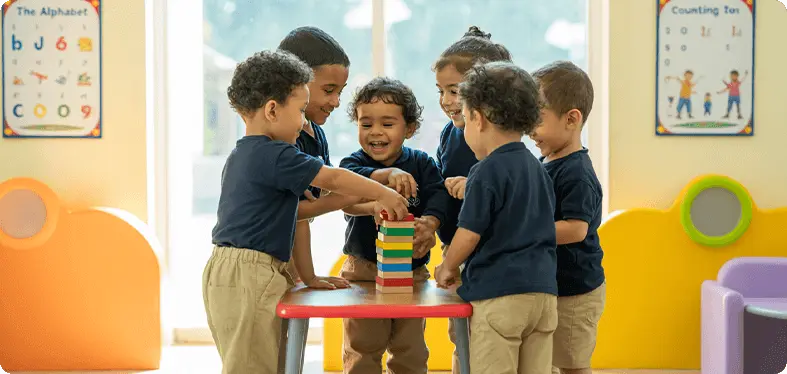
Every parent has watched it happen. The outstretched hand, the sudden tightening of the grip, the toy pulled back to the chest. Young children do not share naturally – this much is universally understood. But what parents in Dubai who care about their Arabic heritage know, and what most nursery curricula still don’t acknowledge, is this: the Arabic language has a vocabulary for friendship and generosity that is richer, more specific, and more beautiful than any generic social-skills curriculum can capture.
Suhba (صحبة). Karam (كرم). Ithar (إيثار). Rahmah (رحمة). These are not simply the Arabic translations of ‘friendship’, ‘generosity’, and ‘compassion’. They are distinct concepts – carrying centuries of Quranic, poetic, and cultural weight – that shape how Arabic-speaking people understand what it means to be a good companion to another human being.
At Alif Ya Nursery – the UAE’s first Arabic-first nursery, with four branches across Nad Al Sheba, Al Mizhar 1, Al Barsha, and Oud Al Muteena – social skills are not taught through visual timers and generic English-language storybooks. They are taught through the Arabic language of companionship itself. This guide explains how – and why it makes a measurable difference to the children who experience it.
“My language. My identity.” – Alif Ya Nursery. And the language through which a child first learns to say ‘this is yours’ shapes who they become.
The Arabic Vocabulary of Friendship: Five Concepts Every Parent Should Know
Before the strategies, the concepts. These words are not decorative – they are the framework through which Alif Ya’s teachers build social and emotional development, from the Butterflies class (45 days old) through to the Knights (age 5–6).
صحبة Suhba – Companionship; the quality of being a true companion. In Islamic tradition, who you keep company with shapes who you become.
كرم Karam – Generosity; giving freely and gladly. A core virtue in Arabic culture – the highest compliment one person can pay another.
إيثار Ithar – Preferring others over yourself. The Quran praises those who ‘prefer others over themselves even when in need’ (59:9). The deepest form of sharing.
رحمة Rahmah – Compassion; mercy; tender-heartedness. ‘Irham man fi al-ard yarhamuka man fi al-sama’ – Show compassion to those on earth, and the One in the heavens will show compassion to you.
إنصاف Insaf – Fairness; giving each person their due. The Arabic concept of justice in social relationships – the foundation of fair turn-taking and conflict resolution.
When a three-year-old at Alif Ya Nad Al Sheba offers a toy to a classmate and a teacher says ‘Ma sha’a Allah – hatha karam!’ (‘How wonderful – this is generosity!’), the child does not just feel praised. They feel named. They understand, at the level at which young children understand everything – through language, through feeling, through repetition – that what they just did has a word, and that word is beautiful, and that it is part of who they are.
This is what no visual timer and no generic storybook about sharing can produce. Language shapes identity. The Arabic language of generosity, used consistently and joyfully from infancy, builds children who do not just perform sharing – they inhabit it.
“I praise Allah who guided me to a nursery that upholds an environment that is Islamic, Arabic, ethical, nurturing, cultural, educational, and scientific.” – Umm Fatimah, Alif Ya parent
How Alif Ya Teaches Social Skills: The Arabic-First Approach at Every Age
The following describes Alif Ya’s age-by-age approach to building social and emotional skills – at all four branches, across all six programmes. Each approach is anchored in an Arabic concept, applied through specific classroom practice.
| Age Group | Alif Ya Class | Arabic Concept | Social Skill Focus | How It Looks in the Classroom |
| 45 days – 11 months | Butterflies 🦋 | Uns (أنس) — familiarity, warmth | Secure attachment; early social trust | Caregivers build the child’s first experience of another person as safe and consistent. In Arabic: ‘Ana huna, habibi.’ (‘I am here, my dear.’) Social trust begins with this. |
| 1 – 2 years | Bees 🐝 | Mubadala (مبادلة) — exchange, give-and-take | Proto-sharing; parallel play; first turn-taking | Teachers narrate exchange moments: ‘Hatha li-ka — this is for you.’ Simple offering and receiving. The Arabic word for exchange enters the child’s world before the concept is intellectualised. |
| 2 – 3 years | Birds 🐦 | Karam (كرم) — generosity; Ithar (إيثار) — preferring others | Intentional sharing; offering before being asked | ‘Ata’a sadeeqahu — He gave to his friend.’ Stories of generosity from Arabic tradition introduced. Children practise choosing to share before being prompted, celebrated with: ‘Ma sha’a Allah, hatha karam!’ |
| 3 – 4 years | Deers 🦌 | Suhba (صحبة) — companionship; Ukhuwwa (أخوّة) — brotherhood/sisterhood | Friendship formation; loyalty; empathy in action | The concept of suhba — that friendship is a trust and a responsibility — introduced through Arabic stories and Friday circle. ‘Sadeequka man yusa’iduka — Your friend is one who helps you.’ |
| 4 – 5 years | Falcons 🦅 | Tahammul (تحمّل) — patience; bearing with others; Insaf (إنصاف) — fairness | Conflict resolution; fairness; waiting with grace | Children negotiate play turns using Arabic language of fairness. ‘Dauri al-aan — It is my turn now.’ ‘Sabrtu — I waited.’ Conflict is resolved, not avoided, in Arabic. |
| 5 – 6 years | Knights ⚔️ | Ta’awun (تعاون) — cooperation; Rahmah (رحمة) — compassion | Community responsibility; leading with kindness; group achievement | Class projects require full cooperation. Children can name what they feel and what others feel in Arabic. Rahmah — compassion — is the word that graduates of the Knights class carry into Year 1. |
Suhba in Practice: What Arabic Companionship Looks Like at Age 3–4
In the Deers class – the 3–4-year-old group at every Alif Ya branch – the concept of suhba is introduced not as a lesson but as a daily lived experience. Children in this group begin to form genuine friendships: sustained relationships with specific peers that involve loyalty, preference, and real emotional stakes.
Alif Ya’s teachers in the Deers class introduce the word suhba in the context of those friendships. ‘Hadi sadeeqatuki wa anti suhbataha – Hadi is your friend and you are her companion.’ The language is specific. It is not ‘she is nice to you’ – it is ‘you are her companion,’ which carries with it the weight of responsibility.
In Arabic tradition, your companion is someone you are accountable to. That accountability, planted at age three, is the foundation of lifelong social integrity.
Karam and Ithar: Teaching Generosity Beyond ‘Taking Turns’
Most nurseries teach sharing through the mechanics of turn-taking: the visual timer, the counting game, the structured rotation. These tools work – and Alif Ya uses structured routines too. But the Arabic framework goes further, because Arabic makes a distinction that English does not.
Karam – generosity – is when you give what is yours gladly, without being asked and without resentment. Ithar – preferring others – is when you give what is yours even though you want it. These are two different moral achievements, and the Arabic language marks the difference.
At Alif Ya, teachers in the Birds class (age 2–3) begin to use these words in the moments when children spontaneously offer: ‘Subhana Allah, hatha ithar – Glory to God, this is ithar, preferring your friend.’ The child who hears this does not just feel praised for sharing. They feel recognised for something extraordinary.
“From the moment I walked into Alif Ya Nursery, I felt an immediate sense of peace and trust. The environment is exceptionally clean, well-organised, and thoughtfully designed for young children.” – Umm Mariam, Alif Ya parent
Friday as Social Training: The Weekly Practice of Community
Alif Ya’s Friday tradition – where children perform wudu, join congregational prayer, and observe the special quality of the day – is, among other things, the most powerful weekly social skills lesson in any nursery in Dubai. Standing in a line. Waiting for others. Moving together. Listening in silence. Rising together. These are not abstract social skills exercises. They are specific, embodied practices of community – performed in Arabic, in the presence of peers, every week.
The child who has been doing this since the Bees class (age 1–2) arrives in the Knights class (age 5–6) having practised communal patience, embodied fairness, and collective rhythm for four years. No turn-taking game produces this. The Friday practice does.
Alif Ya Nursery Across Dubai: Arabian Preschool in Nad Al Sheba, Al Mizhar & Al Barsha
Alif Ya’s Arabic-first social skills environment is available at four branches across Dubai – each serving a specific community of families who want their children’s earliest social experiences shaped by the Arabic language and Islamic values of companionship and generosity.
| Branch | Location | Serves Families In | Admissions Contact |
| Alif Ya Nad Al Sheba | Nad Al Sheba 1, Dubai | Nad Al Sheba, Meydan, MBR City, Downtown Dubai area | alifyanursery.ae/en | +971 52 125 5721 |
| Alif Ya Al Mizhar 1 | Al Mizhar 1, Dubai | Al Mizhar 1 & 2, Mirdif, Al Warqa, Rashidiya | alifyanursery.ae/en | +971 52 125 5721 |
| Alif Ya Al Barsha | Al Barsha, Dubai | Al Barsha 1/2/3, Al Quoz, JVC, Motor City | alifyanursery.ae/en | +971 52 125 5721 |
| Alif Ya Al Mizhar 4 (Oud Al Muteena) | Oud Al Muteena, Dubai | Oud Al Muteena, Al Nahda, Al Qusais, Al Twar | alifyanursery.ae/en | +971 52 125 5721 |
Nursery in Nad Al Sheba – Alif Ya Nad Al Sheba
For families in Nad Al Sheba, Meydan, and Mohammed Bin Rashid City, Alif Ya Nad Al Sheba is Dubai’s only Arabic-first nursery within the community. In a neighbourhood where most nurseries offer EYFS or Montessori curricula with Arabic as a weekly subject, Alif Ya offers something categorically different: Arabic as the primary language of every friendship formed, every conflict resolved, every moment of generosity celebrated.
Families searching for nursery in Nad Al Sheba, preschool in Nad Al Sheba Dubai, or Nad Al Sheba daycare who prioritise Arabic language and Islamic values will find no equivalent in the area. Alif Ya Nad Al Sheba is the address.
Nursery in Al Mizhar 1 – Alif Ya Al Mizhar 1
Al Mizhar is one of Dubai’s most established Arabic-speaking communities – and Alif Ya Al Mizhar 1 is the only Arabic-first nursery within it. For families looking for a nursery in Al Mizhar 1, preschool in Al Mizhar 1 Dubai, or simply the best nursery in Al Mizhar 1, this branch offers the complete Alif Ya experience in the community where Arabic is already the home language – creating a seamless environment of Arabic immersion that extends from the family living room to the classroom and back again.
Nursery in Al Barsha – Alif Ya Al Barsha
Al Barsha is one of Dubai’s most family-dense communities, with thousands of Arabic-speaking and Muslim families who have historically had to choose between geographic convenience and cultural alignment. Alif Ya Al Barsha ends that compromise. For parents searching nursery in Al Barsha, Al Barsha nursery, or nursery admission Al Barsha, the question is no longer which generic nursery is closest – it is whether an Arabic-first environment, with suhba and karam at its heart, is what they want for their child.
It is the only nursery in Al Barsha where social skills are taught through the Arabic language of companionship. That is not a marginal distinction. For the families this nursery was built for, it is the only distinction that matters.
How to Apply for Nursery Admission at Alif Ya: A Step-by-Step Guide
Nursery admission in Dubai – particularly for the most sought-after places – moves faster than many parents expect. At Alif Ya, spaces across all four branches are available now, and the admission process is designed to be straightforward and personal. Here is what to expect.
Step 1: Book a private tour
The most important step is visiting the branch closest to your home. Book through alifyanursery.ae/en or call/WhatsApp +971 52 125 5721. During the tour, you will see the learning environment, meet the teaching team, and have your questions answered by the nursery manager. Tours are available at all four branches.
Step 2: The initial consultation
Once you have visited and decided to proceed, an initial consultation is arranged with the nursery manager to discuss your child’s age, any specific needs, and the appropriate programme group – whether that is Butterflies (45 days–11 months), Bees (1–2 years), Birds (2–3 years), Deers (3–4 years), Falcons (4–5 years), or Knights (5–6 years).
Step 3: Registration documentation
Documents required for nursery admission at Alif Ya Dubai include a valid government-issued ID for parents (Emirates ID or Passport), the child’s birth certificate, the child’s vaccination record, and a passport-size photo. All documentation is handled directly with the branch team.
Step 4: Enrolment confirmation
Once documentation is submitted and the place is confirmed, the branch team will provide an orientation pack and information about the first week – including settling-in procedures, daily schedule, and how the nursery communicates with parents throughout the term.
For nursery admission Al Barsha, nursery in Al Mizhar 1, or preschool in Nad Al Sheba: contact the relevant branch directly through alifyanursery.ae/en or call +971 52 125 5721. Spaces are limited at all branches.
Questions Dubai Parents Ask About Arabian Nurseries and Social Skills
What makes an Arabian nursery different from other nurseries in Dubai?
An Arabian nursery – like Alif Ya – is built around Arabic language as the primary medium of all learning, play, and social interaction, combined with Islamic values and Emirati cultural identity as the lived foundation of daily life. The difference is not cosmetic.
In most Dubai nurseries, Arabic is a subject – a daily or weekly class. At an Arabian nursery, Arabic is the environment. Social skills like sharing, friendship, and empathy are taught through Arabic concepts – suhba (companionship), karam (generosity), rahmah (compassion) – that no EYFS curriculum can replicate.
How do nurseries teach sharing and social skills to toddlers?
At Alif Ya, social skills are taught through Arabic language, consistent daily routines, and age-appropriate peer interaction – beginning as early as the Bees class (age 1–2). Rather than relying solely on visual timers or reward systems, teachers narrate moments of generosity and companionship in Arabic, giving children words for what they are experiencing and feeling. ‘Hatha karam – this is generosity.’
‘Sadeequki tantadhiru – your friend is waiting.’ Language shapes social behaviour at the ages when both language and behaviour are most plastic.
What age should a child start nursery in Dubai?
Alif Ya accepts children from 45 days old in the Butterflies programme. Research consistently shows that children who enter high-quality early childhood environments in the first year of life benefit significantly in language development, social skills, and emotional regulation. For Arabic-first education specifically, the earlier the better – because neural plasticity for native-level language acquisition peaks in the first three years of life.
A child who starts at Alif Ya at 45 days and completes the full programme through the Knights class will have spent six years building Arabic as a primary language.
Is Alif Ya suitable for non-Arabic-speaking families?
Yes. Alif Ya welcomes families of all backgrounds, and a growing number of Alif Ya families do not speak Arabic at home. These families have made a deliberate choice to give their children Arabic fluency and Islamic cultural grounding during the critical window of early childhood.
Young children adapt to immersive environments with remarkable ease – within weeks, children from non-Arabic-speaking homes are participating fully in the Arabic-language classroom. English continues to develop naturally through Dubai’s English-dominant environment outside the nursery.
How do I apply for nursery admission in Al Barsha, Nad Al Sheba, or Al Mizhar Dubai?
Applications for all four Alif Ya branches – Nad Al Sheba, Al Mizhar 1, Al Barsha, and Al Mizhar 4 (Oud Al Muteena) – are made through the nursery website at alifyanursery.ae/en or by calling/WhatsApp +971 52 125 5721. The process begins with a tour, followed by a consultation, document submission, and enrolment confirmation. Spaces are limited at all branches; early application is strongly recommended.
What is the Creative Curriculum, and why does Alif Ya use it?
The Creative Curriculum is an internationally respected, play-based early childhood framework developed in the United States and used in high-quality nurseries worldwide. It was designed around the principle that children learn through meaningful play, exploration, and relationship – not instruction.
Alif Ya chose it because it is structurally the most compatible framework with full Arabic immersion: all learning happens through doing, exploring, and conversing – in Arabic. The curriculum has been adapted by Alif Ya to reflect Arabic language, Emirati cultural identity, and Islamic values throughout.
Is Alif Ya a bilingual nursery?
Alif Ya is an Arabic-first nursery, not a bilingual nursery in the 50/50 sense. Arabic is the primary language of all daily life – play, routines, stories, prayer, conflict resolution, and celebration. English is not excluded, but it is not the medium of instruction. This distinction matters for families who want deep Arabic fluency and cultural connection rather than equal-time bilingual exposure.
In Dubai’s English-dominant environment, Arabic requires concentrated nursery support to develop at the depth that families who care about their heritage want for their children.
How does Alif Ya handle conflict between children?
At Alif Ya, conflict between children is handled in Arabic, with attention to the feelings and relationships involved rather than simply the rules broken. Teachers use the Arabic vocabulary of fairness (insaf) and compassion (rahmah) to guide children through resolution: ‘Kayfa yashur sadeequk? – How does your friend feel?’ ‘Madha yumkinuka an taf’al? – What can you do?’
Children learn that conflict is an opportunity to practise the values of suhba – that a true companion repairs, not just retreats. By the Knights class, children can name what they feel and what others feel in Arabic, and they take the initiative to repair social damage themselves.
Book a Tour at Your Nearest Alif Ya Branch
Social skills are not a subject you can teach in a single lesson. They are built across thousands of small moments – every offer, every wait, every repair – over the first six years of a child’s life. At Alif Ya, every one of those moments happens in Arabic. Every expression of generosity is named karam. Every act of patience is named tahammul. Every friendship deepened is named suhba.
Children who grow up with this vocabulary do not just learn to share. They understand why sharing is beautiful. And they have the language to say so.
Four branches across Dubai. Nad Al Sheba, Al Mizhar 1, Al Barsha, Al Mizhar 4 (Oud Al Muteena). From 45 days to 6 years. The UAE’s first Arabic-first nursery – where the art of friendship is taught through the Arabic language of friendship.