In February 2025, Dubai’s Knowledge and Human Development Authority — KHDA — announced something that changed the early childhood education landscape across the emirate: Arabic language learning is now mandatory in all private nurseries and early childhood centres, for children from birth to six years old.
If you’re a parent with a child in nursery, or about to start looking for one, this policy matters to you. It changes what every licensed nursery in Dubai must now provide. And depending on where your child is enrolled, it may represent a significant shift in what they experience every day.
This guide explains the policy clearly — what it says, what it requires, how it’s being phased in, and what it means for your child’s development. And it explains why, for families who want their children in a nursery where Arabic isn’t an add-on but the living, breathing heart of the learning environment, Alif Ya was already doing all of this — before the mandate existed.
“Arabic is at the heart of the UAE’s cultural identity, and it is essential that we instil a love for the language in all our children from the earliest stages of their education.” — Fatma Belrehif, CEO of the Education Quality Assurance Agency at KHDA
The KHDA Arabic Language Policy: What It Actually Says
The policy — formally known as the Policy on Arabic Language Provision in Early Childhood Education — is part of Loughat Al Daad, one of the 28 strategic initiatives under Dubai’s Education 33 framework. It was announced in February 2025 and is being implemented in three phases across all KHDA-licensed nurseries and early childhood centres.
What the policy requires
- Arabic for all children, not just Emirati or Arab families. The policy covers both native Arabic speakers (for whom Arabic is their mother tongue) and non-native speakers (for whom it is an additional language). Every child in every licensed Dubai nursery will receive Arabic language provision.
- At least one-third of instructional time must involve a qualified Arabic teacher engaged in daily activities with children — including student-led, whole-group, and small-group sessions.
- A play-based, inquiry-driven approach. KHDA specifically requires that Arabic be taught through immersive, culturally relevant, child-led experiences — not rote memorisation or formal lessons. Arabic should be woven into songs, stories, daily routines, and play.
- Qualified Arabic teachers with a minimum of 20 hours of professional development annually, focused on language acquisition, play-based learning, and inquiry-driven approaches.
- Transparent parent communication. Nurseries must clearly communicate to families which Arabic language model they are implementing, and actively involve parents in supporting Arabic development at home.
- Evidence of progress. KHDA will assess sector-wide Arabic language outcomes, requiring nurseries to document and demonstrate children’s progress in Arabic acquisition.
The Three-Phase Rollout
The policy is being phased in over three academic years to allow nurseries time to hire and train qualified staff, develop compliant curricula, and adapt their learning environments.
| Phase | Age Group | Start Date | What It Means for Your Child |
| Phase 1 | 4 to 6 years | September 2025 (April 2026 for April-start schools) | Compulsory Arabic learning begins for pre-K and KG age groups |
| Phase 2 | 3 to 4 years | Academic year 2026–2027 | Arabic education extends to younger toddlers and twos |
| Phase 3 | Birth to 3 years | Academic year 2027–2028 | All children from infancy will receive Arabic language provision |
By 2027–2028, every child from 45 days old in every licensed Dubai nursery will be entitled to Arabic language provision. The policy is comprehensive and non-negotiable — it applies to every private early childhood setting in the emirate, regardless of their primary curriculum framework.
What This Means for Your Child — and for You as a Parent
If your child is currently enrolled in a nursery that follows a British EYFS, Montessori, American Creative, or other international curriculum, their nursery is now required to integrate Arabic into the daily learning environment — not just as a weekly language class, but as a living presence throughout the day.
This is a meaningful shift for many families. Here’s what it means in practice.
For Emirati and Arabic-speaking families
The policy formalises what many Arabic-speaking families have long wanted but struggled to find: a guarantee that their child’s mother tongue will be nurtured, honoured, and developed with the same seriousness as English or any other language. A child who grows up hearing, speaking, and playing in Arabic from their earliest months develops a relationship with the language that no amount of formal tuition in later school years can replicate.
The policy is also an acknowledgement of something deeply important: that language is identity. A child who feels confident in Arabic feels connected to their heritage, their extended family, their community, and the country they call home.
For non-Arabic-speaking families and expatriates
The policy applies equally to non-Arabic-speaking children — and this is one of its most thoughtful dimensions. KHDA is not asking non-Arab children to become fluent in Arabic overnight. It is creating the conditions for natural, joyful, early exposure to a language that is woven into the culture of the country these children are growing up in.
Research consistently shows that children who receive early exposure to a second language — especially through immersive, play-based methods — acquire it with remarkable ease and without displacing their home language. A child who spends their early years in an Arabic-rich environment in Dubai doesn’t just gain a language skill. They gain a genuine connection to the place they’re growing up in, and the confidence to navigate a bilingual world.
Early childhood is the single most powerful window for language acquisition. The neural pathways that make language learning effortless close gradually after the age of seven. A nursery that genuinely immerses children in Arabic during these years gives them a gift that cannot be replicated by a language tutor at age twelve.
For parents comparing nurseries
The policy has raised the floor for Arabic provision across Dubai. Every licensed nursery must now have it. But there is a significant difference between a nursery that is adapting to the policy — hiring Arabic staff, redesigning its curriculum, building new systems from scratch — and a nursery where Arabic has been the foundation since the first day the doors opened.
That difference is Alif Ya.
Why Alif Ya Was Already Ready — and What That Means for Your Child
Alif Ya Nursery was founded on a single, clear belief: that Arabic language and Emirati heritage deserve to be the foundation of early childhood education, not an optional extra, not a weekly class, not a compliance checkbox. We are the UAE’s first Arabic-first nursery — built from the ground up around the principles that KHDA’s policy is only now requiring of others.
While most Dubai nurseries are now adapting to meet the KHDA mandate, Alif Ya has been living it since we opened our doors.
Here is an honest comparison of what the policy requires versus what Alif Ya already provides — and has always provided.
| KHDA Policy Requirement | Most Dubai Nurseries — Starting Now | Alif Ya Nursery — Always |
| Arabic integrated daily (not just as a subject) | Adapting — building new structures | ✅ Arabic has always been the daily environment |
| Qualified Arabic teachers in 1/3 of instructional time | Recruiting / upskilling staff now | ✅ Native Arabic educators from Day 1 |
| Arabic through play, songs, routines — not rote | Developing play-based Arabic resources | ✅ This is the only teaching method we use |
| Cultural and Emirati values embedded | Adding cultural elements to existing curriculum | ✅ Heritage and identity are our founding principles |
| Arabic for native AND non-native speakers | Building differentiated models for the first time | ✅ Differentiated approach in place from opening |
| Annual teacher Arabic professional development | Designing and sourcing training programmes | ✅ Continuous CPD embedded in our model |
This is not a boast. It’s a structural reality. Building an Arabic-first environment from the ground up is a fundamentally different exercise from adding Arabic provision to a pre-existing English-language framework. The difference shows in a child’s daily experience — in how they hear Arabic, how they use it, how naturally they reach for it when they want to express something, and how proud they feel about the language they’re growing up in.
What Arabic-first looks like inside an Alif Ya classroom
At Alif Ya, Arabic isn’t a subject on the timetable. It’s the medium through which everything happens. When children arrive in the morning, they’re greeted in Arabic. When they sit in a circle, the conversation is in Arabic. When they paint, build, explore, and play, the words their teachers offer them are Arabic words. The books on the shelf are Arabic. The songs they learn are Arabic. The celebrations they mark — from Eid to National Day to the weekly Friday prayer tradition — are rooted in Arabic culture and language.
The Creative Curriculum we implement — internationally respected and globally used — has been thoughtfully adapted to ensure that every learning experience is culturally and linguistically grounded in Arabic identity. Children don’t learn Arabic because they have to. They live in it because it’s the world around them.
Friday at Alif Ya — A tradition no policy can manufacture
One of the things that makes Alif Ya Nursery genuinely distinct — and which no KHDA mandate can create overnight — is the culture of the nursery itself. On Fridays, children take part in meaningful Islamic traditions: learning about the significance of the day, practising wudu, and joining a guided congregational prayer in a calm, respectful atmosphere. This isn’t a programme. It’s a way of being.
Children who grow up in this environment don’t just learn Arabic as a language. They develop a relationship with it — a sense that this language belongs to them, that it connects them to something real and beautiful and important. That relationship, built in the earliest years, is one of the most valuable things a nursery can give a child.
Parent Questions About the KHDA Arabic Policy and Nursery Choice
Is Arabic now compulsory in all Dubai nurseries?
Yes. The KHDA Policy on Arabic Language Provision in Early Childhood Education mandates Arabic language learning for all children from birth to six years old in all private nurseries and early childhood centres licensed in Dubai. Phase 1 (children aged 4–6) began in September 2025. Phases 2 and 3 will extend the requirement to all children from birth by the 2027–2028 academic year.
What is Loughat Al Daad?
Loughat Al Daad — meaning ‘the language of Daad’ (Daad being a letter and sound unique to the Arabic language) — is one of the 28 strategic initiatives under Dubai’s Education 33 framework. It is KHDA’s initiative to strengthen Arabic language acquisition in early childhood and to nurture a deeper understanding of UAE culture and heritage from the earliest years of life.
How is Arabic meant to be taught under the new KHDA policy?
KHDA specifically requires that Arabic be taught through play-based, inquiry-driven, culturally relevant methods — not rote memorisation or formal academic instruction. Arabic should be embedded in daily activities, songs, stories, and routines, and delivered by qualified Arabic-speaking educators. The policy explicitly moves away from Arabic as a standalone subject toward Arabic as an integrated part of the daily learning environment.
What is an Arabic-first nursery, and how is it different from a nursery with Arabic classes?
An Arabic-first nursery is one where Arabic is the primary language of the learning environment — the medium through which daily life, play, and learning take place — not simply a subject period within an otherwise English-language day. Alif Ya is the UAE’s first Arabic-first nursery. In a nursery with Arabic classes, children receive perhaps 30–60 minutes of Arabic per day in a dedicated session. In an Arabic-first environment, they are immersed in Arabic throughout the entire day.
Is Alif Ya Nursery suitable for non-Arabic-speaking families?
Yes. Alif Ya welcomes families of all backgrounds, and many of our families are non-Arabic-speaking. Early childhood is the optimal window for language acquisition, and children in an Arabic-rich environment learn naturally and joyfully — without pressure, without formal drilling, and without displacing their home language. Many non-Arabic-speaking parents tell us their children began using Arabic words and phrases within weeks of joining, and that this gave the whole family a deeper connection to the UAE.
Will other nurseries meet the KHDA Arabic requirement?
Over time, yes — all licensed nurseries are required to comply with the phased rollout. However, compliance and genuine immersion are not the same thing. A nursery that is adapting its existing model to meet the requirement will provide Arabic provision. A nursery that was built around Arabic from the beginning — with native Arabic educators, an Arabic-adapted curriculum, and a cultural identity rooted in the language — provides something that compliance alone cannot replicate.
Does Alif Ya follow a recognised international curriculum?
Yes. Alif Ya implements the Creative Curriculum — an internationally respected, play-based, child-centred framework widely used across the US, UK, and internationally — which has been thoughtfully adapted to reflect Arabic language, Emirati values, and cultural identity. Children benefit from a globally recognised learning approach while being deeply rooted in their Arabic heritage.
Where are Alif Ya’s nurseries in Dubai?
Alif Ya Nursery has four branches across Dubai: Nad Al Sheba, Al Mizhar 1, Al Barsha, and Al Mizhar 4 (Oud Al Muteena). We welcome children from 45 days old through to kindergarten age (5–6 years).
Dubai Is Moving Toward Arabic. Alif Ya Has Always Been There.
The KHDA’s Arabic language mandate is a meaningful and welcome development for early childhood education in Dubai. It moves the entire sector toward something Alif Ya has believed since before we opened: that Arabic isn’t an optional element of a good nursery in the UAE — it is the foundation.
For families who want their child in a nursery that meets this mandate — not because it has to, but because it was built this way from the very beginning — the choice is clear.
Alif Ya Nursery. The UAE’s first Arabic-first nursery. Four branches across Dubai. 45 days to 6 years. And a philosophy that KHDA’s latest policy simply confirms was right all along.
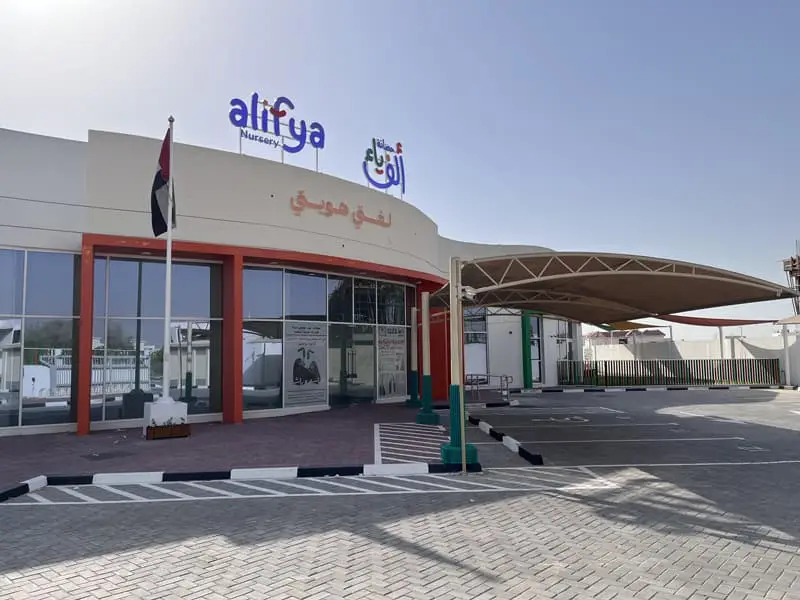
Book a private tour at any of our four Dubai branches and see what an Arabic-first learning environment actually looks and feels like — for your child and for your family.